Airline pilots almost always talk to the ground crew using headsets during pushback. On the other hand, general aviation and private jets usually don’t push back from gates, and many smaller planes cannot plug in the headsets, which allow for direct communication. Even at the airline level, headsets don’t always work. For these reasons, pilots and ground workers share a standard communicative method of using hand signals. Let’s talk about the importance of marshaling gestures.
Taxi in
Hand signals, also known as marshaling, are used during taxi in, pushback, engine start, and taxi out. The most common hand signals are those used to marshal an arriving aircraft onto its parking stand. Marshaling an arriving aircraft requires no fewer than two ground agents: One standing at the top of the lead-in line and another at the back of the “safety envelope.” The latter-mentioned marshaller is there to ensure the parking area is free of obstructions and to ensure wingtip clearance during parking. If satisfied with the circumstances, they hold one baton over their head and another parallel to the ground. They can signal the pilots to stop taxiing the aircraft by crossing their batons.
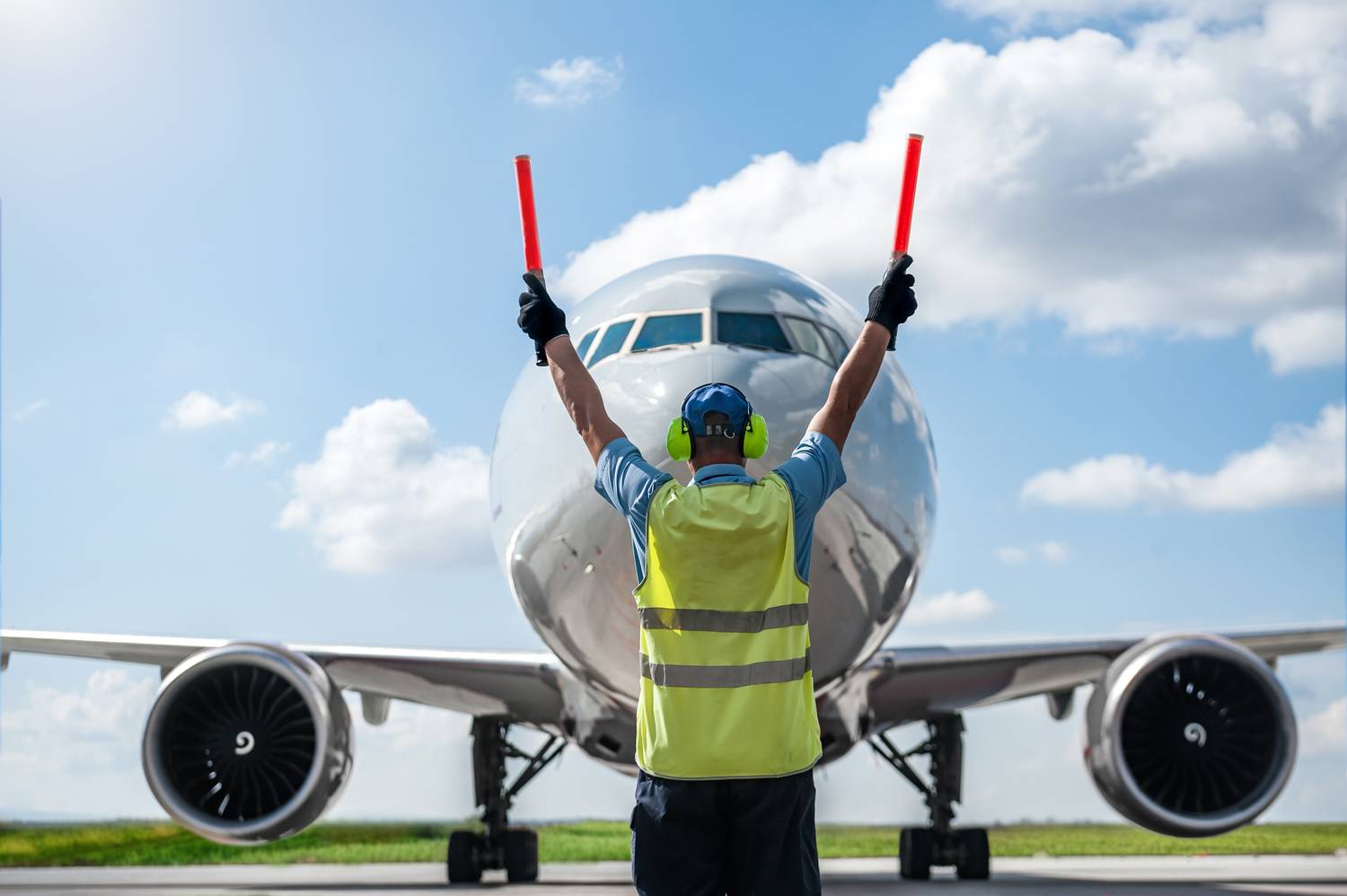
Photo: PedkoAnton I Shutterstock
The marshaller at the top of the lead-in line is strategically placed to remain in the pilot’s view until the plane has stopped. They give directional instructions to help the pilots track straight on the line. Their marshaling signals are intuitive—they flick or gesture with a baton in the direction they want the nose to turn to correct for the lead-in line. As the aircraft nears its designated parking line, the marshaller lifts their hands over their head and slowly brings their arms together to measure the remaining distance. The plane should be at a standstill as soon as their arms cross over their head with batons in hand. While this type of marshaling is still common practice at most places, some airports use automated parking indicators.
Push and start
Pushbacks usually require a four-person team: A tug driver, a lead marshaller, and two wing-walkers. Hand signals are used when the driver or lead marshaller is not in voice contact with the pilots. To commence a pushback, the pilots indicate that the brakes are released by showing a clenched fist and opening their hands palm-out or by moving two clenched fists away from each other. The ground crew then indicates the removal of the chocks by moving their hands from their side outwards and upwards.
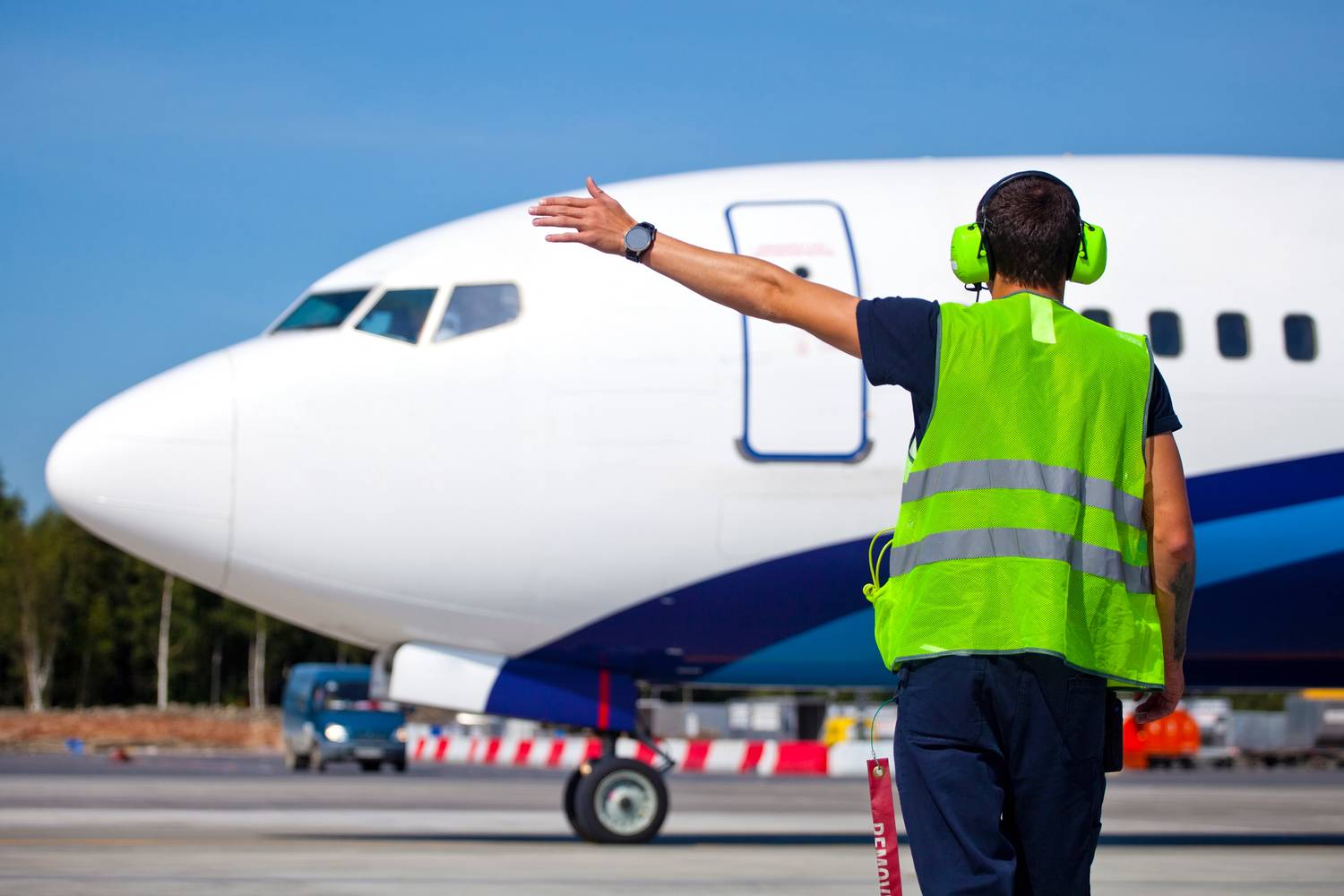
Photo: JetKat I Shutterstock
The pilots indicate the direction they want the nose to face by touching their nose with one finger and then pointing in the desired direction. A thumbs-up is then understood as the signal to commence the push. During or after the pushback, the ground crew can signal to start engines by pointing to the engine and spinning their baton overhead in a circular motion. Alternatively, they can indicate which number engine is allowed to be started by holding up that many fingers and repeating the circular baton movement. The ground crew indicates to set the parking brake after the push by bringing their hands or batons together, and the pilots respond in part once they have done so. After the tug is disconnected and personnel are clear of the plane, a marshaller points their baton in the direction the aircraft will commence taxi. Waves (or bows in Japan) are also usually exchanged.
Hands-on
There are other non-movement hand signals, such as for plugging in ground power (bringing a flat hand fingers-first towards an open palm) or connecting the yellow air conditioning tube to the bottom of the plane (bringing a mask-shaped hand towards the nose and mouth). Hand signals for pushback aren’t all that common in airline operations, so ground crews and pilots typically brief the procedure before doing it. On the other hand (pun intended), general aviation and private pilots might use hand signals for start and taxi-out much more regularly. Regardless of the type of operation, hand signals relay essential messages between the flight deck and the ramp.